Monday, August 20, 2012

What a great summer it has been!

The Chesapeake Bay has benefited greatly from the lower amounts of rainfall and subsequent reduced runoff of water that come with it.  The Bay's dead zones that exist without oxygen have been smaller, the fish have ventured farther north, and the spawning female crabs swimming south have happened in some of the largest numbers seen in recent years. The reduced algae blooms have left the middle Bay a bit clearer and promoted the growth of sea grasses that are crucial for the Bay ecosystems.  Fishing Creek has seen some of the first Terrapins (Native Bay turtles) live and lay eggs in the creek in many years.

Terrapin caught in crab pot


Of course lower rainfall also brought record Sea Nettle (Jelly fish) counts to the middle Bay, and more barnacles for boat bottoms.

Hurricane season has also been a bit different this summer, with storms staying well south or east of the US East Coast.

NWS logo - Click to go to the NWS homepage
Track Hurricanes at http://www.nhc.noaa.gov/

For this Autumn, there are many predictions as to what we will expect.  For us in Oyster Harbor we can probably expect at least one Tropical Storm to past by and leave some rain and wind before November.  We can also expect the consistent mix of mild and hot days, with the occasional summer thunderstorms.  Rumor has it that the fishing this fall will be better than normal.

As for new things affecting the Piers and Harbors, we have a big list of accomplishments this summer.

  • The Fishing Pier is complete (along with the dredging of the channel and new bulkheads)
  • We have added floating docks to Fishing Creek and Booker Ave piers for dinghy and kayak launching and for  leased space available to store small boats on those floating docks.
  • We have added the ability to pump out port-a-potties (portable types) at the Pump out on Booker Pier
  • We have fixed and expanded signs at beaches and piers to more clearly define rules and usage.
  • We have also gotten stricter about enforcing boats, trailers, and cars that are left in places that block the open use of the piers or parking areas by others.
  • We added an online Slip Request form on the Piers and Harbors Blog to apply for a slip or dinghy dock

New dinghy floating dock details
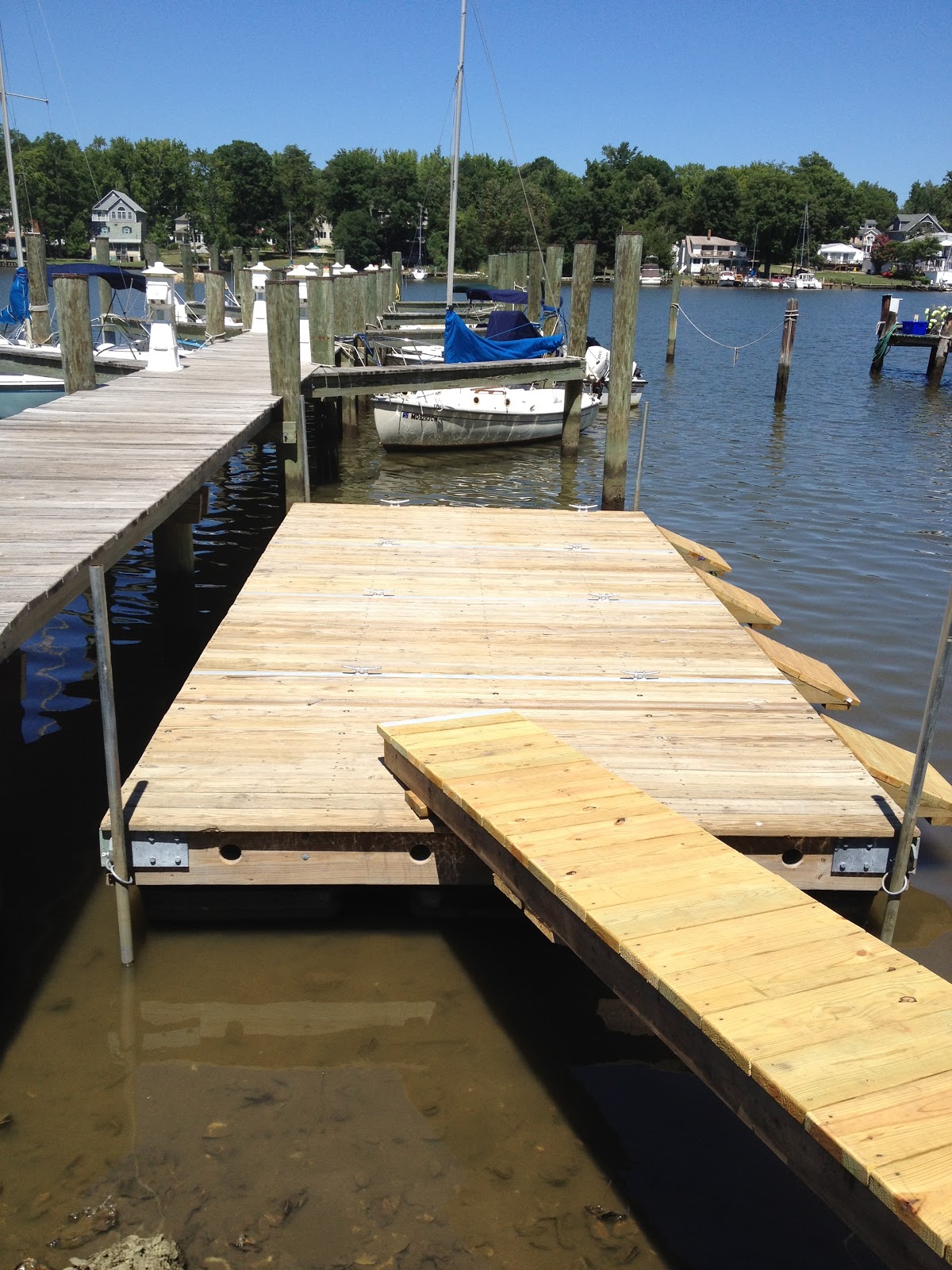


We have one new dock as Fishing Creek.  It can hold four dinks, kayaks, lasers, sunfish, or other similar sized boat.  Each space is 3.5' x 10' and has tie downs to secure your boat.  Half of the original white dock at Fishing Creek is reserved for boat launching, crabbing, and short term tie ups.

On Booker/Washington Pier we added two floating docks, with a total of seven spaces available.  Four spaces are 3.5' x 10 feet, three are 2.5' x 10' for kayak width boats only (kayaks by be up to 14'), and one is 2.5 feet by 10' where the kayak must be 10' or less. All spaces have tie downs.  Both floating docks have the right side reserved for boat launching.  The one near shore has a ramp to make launching easier.

Leased Spaces are available on a first come, first serve basis, with preference given to those who are less able to carry boats from the racks to the water. 

If you'd like to lease floating dock space or a slip, click on the slip request button above.


We'd also like to thank all the residents who went out of their way to report boats that were taking on water, help find lost boats, and in one case go out of their way to bail out a boat at 2am in high winds.  I believe that because of this care for others in the community, we did not have a single boat sunk, and found the one lost boat that blew away.  Thank you!

Don't think this winter will be as mild as last year. Plan ahead!

On a final weather note, last winter was remembered as the "Winter that wasn't", and many boaters will have that fresh in their minds when planning winterizing and storage for their boats for this winter.  We remind you that the last time this area had such a mild winter was in 1955.  And, only a couple years ago we had the "Snowmageddon".   Winters can vary greatly from year to year in our area, so please plan for a much harsher winter this year than last.

As always, if you have suggestions, ideas, find a lost boat, see one near sinking (even at 2am), or want to rent a boat slip, please let us know.

Fair winds and happy boating,

Eric Epstein
Piers and Harbors Chair
~~~~~(\~~~~~

Thursday, July 19, 2012

Online Slip Requests

Over the last two years we have made a big effort to bring the Internet and automation to the Oyster Harbor slip lease process.  So far, we have started a Blog, converted to PDF based slip leases that are sent by email, created an online database of slip holders and emergency contact info (not publically view-able), and track piers projects online with an internal database.  


This week we added an online slip request form, for people to request a new slip, or a different slip.  If you already have a slip lease and are happy with the slip, there is no need to use this form.

Coming soon, we hope to have online work/maintenance request forms and online suggestion forms available.  

If you have any Blog ideas, suggested topics, or Online services you think we can provide, please feel free to email me anytime at Eric@Epstein.Bz.

The Slip request form is available at the top of this Blog.

Safe boating,
Eric

Tuesday, May 22, 2012

Reminders and Information for the Boating Season

Memorial Day is coming, and with it starts the unofficial beginning of the boating season on the Chesapeake Bay.  Here are a few reminders to help everyone get the most out of Oyster Harbor's waterways and piers.


Speed - Watch your speed in the back end of Fishing Creek and near people's docks in Oyster Creek.  Maryland law forbids speeds over 6 knots within 100 feet of boats on moorings, or docks on shore.  The back end of Fishing Creek, near the US Coast Guard station, is a mooring field and a no wake zone.  No matter where you are, you are responsible for your wake!  Watch for kayaks, dinghy sailors and kids in small boats.


Trailers and cars - The parking areas by the three piers are for residents and guests utilizing those areas, and for overflow community parking.  You may not use if to store trailers or leave cars for long term parking.  The community launch ramp has space for only a few cars and trailers.  Please leave your trailer only if you will be gone for a short period.  If you are launching your boat for the weekend, or longer, please take your car and trailer home.  If you leave your boat trailer or car for an extended time, it may be removed at your expense.


Boats left - If you do not have a slip, but want to leave your boat at an OHCA pier for an overnight, send an email to myself or Claire.  We may have a temporary slip for you, or you can use one of the new floating docks we will be adding soon.  Docking your boat for more than an overnight is not permitted.  OHCA has never permitted mooring non-slip leased boats to community docks and will begin enforcing the rule and removing boats that abuse it.


Best of the Bay - Chesapeake Bay Magazine has published its Best of the Bay 2012 list.  Follow the link to find the best places the explore this summer.
http://www.chesapeakeboating.net/Media/Feature-Stories/Best-of-the-Bay-2012.aspx

We wish everyone a happy and safe Memorial Day and Summer boating season.

- Oyster Harbor Piers and Harbors Committee Chair

Monday, March 26, 2012

Slip Contracts are Sent

They are a bit late and a bit different this year, but most of the slip contracts have been sent as PDFs by email to slip holders and those who are at the top of the wait list.


Included in the package is a cover letter, single page renter's agreement and a copy of the Rules and Regulations.

Of course you will still need to print it and write a check. But email is a big step forward.

Did you not get yours?  If so, please contact me ASAP!

Thanks,
Eric

On a completely separate topic, for those who have not seen it yet, here is the Eagle Cam live feed from The US Fish and Wildlife service.


Live broadcast by UstreamYou can read more on it at http://www.wired.com/wiredscience/2012/02/eagle-cam-returns/

Monday, March 19, 2012

Links to Resources for Clean, Green Boating


With Springtime upon us, we begin cleaning and preparing our boats for the new season.  One of the key topics we boaters should consider is pollution caused by our boats - as well as homes, yards, and automobiles.  Below is a fantastic reference from AnnapolisGreen.Com (http://annapolisgreen.com/greenboating.html), which is hosted by Oyster Harbor's own Elvia Thompson.

It is very informative, and complete with links and reference information that make it a one-stop site for Local Environmental Topics.

----------------


Resources for Clean, Green Boating
Chesapeake Bay Safety and Environmental Hotline 877-224-7229 - Call this number to report problems on State waters.
spa creek conservancyFrom the Spa Creek Conservancy ... but applicable to concern about any body of water 
How to Wash and Service Your Boat for a Clean Creek - Keep Trash, Oil, Solvents and Toxics Out of Our Creek

Sewage Issues (from Maryland's Department of Natural Resources)
Tips for protecting our waterways
The most significant threat to the health of the Chesapeake Bay is nutrient overenrichment. When present in excessive amounts, nutrients trigger algal blooms. The algae prevents sunlight from passing through the water column. Aquatic plants suffer as a result. Furthermore, when this algae dies and is decomposed, dissolved oxygen levels can be reduced to the point where aquatic life is threatened.
Boat sewage, whether treated by a marine sanitation device (MSD) or not, contains nutrients. Although one flush form one head on one boat may not add a significant amount of nutrients to the water, the effects of nutrient overenrichment are cumulative and boat sewage can present a particular problem in areas of water that do not flush well and where boats tend to congregate (such as marinas and mooring areas).
Raw or poorly treated sewage also contains harmful bacteria which is a potential source of disease transmission to swimmers and others who come into contact with contaminated waters. Also, human consumption of shellfish contaminated with sewage can result in serious illness.
  • Use onshore restrooms when docked.
  • Report broken pumpout stations to the Maryland Department of Natural Resources at 410-260-8770.
  • Choose enzyme-based deodorizers for waste in holding tanks or portable toilets.
  • Avoid holding tank products that contain quarternary ammonium compounds (QAC) and formaldehyde. These products may disrupt sewage treatment plants.
  • Share this information with another boater.
clean marinaclean marina flagThe Maryland Clean Marina Initiative is an evolving effort to assist marina, boatyards and yacht club operators to protect the resources that provide their livelihood: clean water and fresh air. The Initiative is distributing a comprehensive pollution prevention guidebook for marinas, recognizes “Clean Marinas” through an awards program, and conducts outreach activities to further promote environmentally responsible marina and boating practices.
Guidebook for Marinas | Certified Maryland Clean Marinas

Tip Sheets for Boaters from the Clean Marina Initiative

Join the The Maryland Clean Boater Program
While the Clean Marina Initiative has provided tools and help to Maryland marinas and boatyards since 1998 to protect the resources upon which their businesses depend — clean water and fresh air — the the Maryland Clean Boater Program was launched in 2007 to help boaters join the effort to protect our waterways.
The Program encourages you to take the Clean Boater Pledge to express your commitment to clean boating habits. The program provides tips and materials to prevent marine pollution.
Check out the Maryland Clean Boater Program website and take the pledge! While supplies last, each boater who returns a Pledge will receive a thank you gift!)
How Can You Be a Clean Boater?
  • Sign the Maryland Clean Boater Pledge by clicking here! (See above.)
  • Don’t litter, and pick up litter when you see it.
  • Learn about and share clean, safe boating habits.
  • Follow laws regarding discharge of sewage, chemicals, and debris.
  • Support Maryland Clean Marinas when possible.
General Clean Boating Tips
For use around marinas and while on the water anywhere: Contain Trash
  • Do no let trash get thrown or blown overboard
  • If trash blows overboard, retrieve it--consider it “crew-overboard” practice
  • Pack food in reusable containers
  • Buy products without plastic or excessive packaging--plastic is deadly to fish and birds
  • Do not toss cigarette butts overboard--they are made of plastic (cellulose acetate)
  • Purchase refreshments in recyclable containers
Recycle
Fuel Cautiously
  • Remember, fuel expands as it warms up
  • Fill your tank just before leaving on a trip
  • If you fill your tank upon your return to port, fill it only 90%
  • Use oil absorbent material to catch drips from the fuel intake and the vent overflow
  • Fill portable fuel tanks ashore--where spills are less likely to occur and easier to clean up
  • Add a fuel conditioner to your tank if you use your engine infrequently
Control Oil In The Bilge
  • Keep your engine well tuned--no leaking seals, gaskets or hoses
  • Place oil absorbent material or a bioremediating bilge boom in the bilge
  • Place an oil absorbent pad under the engine
  • Replace oil absorbent materials regularly
  • Check fuel lines for damage--replace with alcohol resistant hoses
  • Secure fuel hoses to prevent chafing and leaks
  • Never discharge bilge water with a sheen--it is illegal
Properly Dispose of Oil Absorbent Materials
  • If the pad is saturated with gas, allow it to air dry. Reuse.
  • If the pad is saturated with diesel or oil, double bag it in plastic--one bag sealed inside another. Dispose in your regular trash.
  • Bioremediating bilge booms should not be sealed in plastic bags--the microbes need oxygen to function. Discard in regular trash.
Clean Gently
  • Wash your boat frequently with a sponge and plain water
  • Use detergents sparingly
  • Use phosphate-free, biodegradable and non-toxic cleaners
  • Wax your boat--a good coat of wax prevents surface dirt from becoming ingrained
  • Clean wood with a mild soap powder and a nylon brush--not harsh chemical cleaners
  • Conserve water--put a spray nozzle on your hose
Maintain Your Vessel Wisely
  • Collect all paint chips, dust and residue. Dispose in regular trash.
  • Share leftover paint and varnish
  • Bring used solvents and waste gas to local hazardous waste collection day
  • Keep your engine clean so you can spot leaks
  • Slip a plastic bag over used oil filters before they are removed to capture drips
  • Use premium two-cycle engine oil
  • Use alternatives to toxic bottom paints
Sewage
  • Never discharge raw sewage in Maryland waters
  • Use restrooms on shore
  • Under way, use approved Marine Sanitation Devices (MSDs)
  • Discharge Type I or II MSDs over deep water--avoid discharging in swimming areas, marinas, anchorages or over oyster bars
  • Establish regular maintenance schedule for your MSD based on manufacturer’s recommendations
  • Pumpout and rinse hold tanks regularly
  • Use enzyme based products to control odor and reduce solids in holding tanks
  • Avoid holding tank products that contain quarternary ammonium compounds (QAC) and formaldehyde
Dispose Of Fish Waste Properly
  • Do not throw fish waste into marina waters
  • Use fish cleaning stations where provided on docks or at marinas
  • Discard waste over deep water or in the trash
  • Save waste and use as chum or bait
Protect Sensitive Habitat
  • Proceed slowly in shallow areas
  • Do not disturb wildlife
  • Avoid contact with submerged aquatic vegetation (SAV)
  • Watch your wake--it can lead to shoreline erosion and disturb wildlife
Be A Responsible Boater
  • Learn about products and practices which are environmentally safe
  • Share the information with other boaters
  • Help guests understand that, on your boat, no trash is thrown overboard
  • Obey laws governing speeding, littering and discharge
  • Encourage boating facilities to provide trash cans, recycling bins and pumpout stations
  • Support marinas that are environmentally responsible

Thursday, February 9, 2012

Springtime in Oyster Harbor Piers, and First Annual Survey


As the “Winter that Never Happened” passes, and signs of Spring threaten to show themselves along our shores and marsh, it’s also time to think about boating again.


Our community has a strong connection with the surrounding Bay and creeks, and we want to ensure OHCA residents can get the most from these waters.  Each year we try to improve our Piers and Harbors wherever we can.  The addition of a pump-out on the Booker Street pier has saved many boaters the long trip to Annapolis for a pump out.  Electricity and dock upgrades have made keeping your boat in a slip easier and more enjoyable.

We are always looking for ways to improve the services we offer.  To aid us, we have created a questionnaire with a few questions that can help us gauge what new services to offer the community.  Please take 2 minutes and fill it out at OHCA Piers Survey


If you own a boat, one of the big logistics items is taking care of where to dock it.  Fortunately Oyster Harbor offers multiple docks and racks for boat storage.  Here is a list of things to help you plan where to keep your boat in 2012.


Dinghy Racks
  • If you have your boat in a dinghy rack, please check to make sure its sitting safely and not about to fall off. 
  • Check that it is locked and protected from UV rays.
  • Check that your OHCA sticker is visible.  If not, contact Claire at Manager@oysterharbor.org for a sticker.


Slips
  •  If you have a slip lease, please email (Eric Epstein) eric@epstein.bz or Manager@oysterharbor.org to let us know if you plan to renew your slip for the May 2012 to April 2013 Lease year.
  •  If you left your boat tied up to a pier in 2011, but did not have a slip.  Contact Eric Epstein for a slip.  In 2012 OHCA will begin removing boats that do not have slip leases.
  • If you see maintenance that is needed on your slip, please let us know so we can schedule repairs.  This includes electrical issues.
  • Refresh your familiarity with the OCHA Piers and Harbors Regulations.
  •  Ensure your boat's liability insurance, or homeowners insurance is current and covers your boat and damage it may cause to piers or to other boats
  • Ensure your Maryland boat registration is current
  • Think about who may be using the boat this year and if they will need to have a Maryland Boater Safety Course to operate the boat

Please don’t hesitate to contact us with any questions or concerns.

Eric Epstein, Piers and Harbors Chairman, 410-575-4001

Spring also includes that annual rite and hallowed seafaring tradition of “Spring Commissioning”.  In case you don’t have a handy check list of spring boat preparation tasks, here is a list of combined boat, sailboat, and engine to dos that may make the chores a bit easier.


Kayaks, Row Boats and other small boats
  • Inspect the seats, hull, fittings and dolly for damage from winter weather and wear from last year
  • Inspect your safety gear and change batteries in non-rechargeable devices.
  • Make sure you have up to date charts on the areas you plan to venture to
  • Replace lines, fix sails, and inspect for wear on all the movable parts of the boat and riggings
  • Refresh your knowledge of Maryland regulations for life jackets, fire extinguishers,safety gear, etc.


Outboard Motors
  • Replace spark plugs.
  • Check external gasoline tanks for corrosion, and replace if necessary. Look for cracks in the priming bulb, and test it for firmness and resiliency. If it collapses, replace it.
  • Note the color of the lube oil in the lower unit. If it’s cloudy, there’s probably a leak around the prop-shaft seal. Fix it and change the oil.
  •  Look for leaks around the trim cylinders.
  • Check for corrosion around the lower unit and on accessory items such as electronic tilt motors


Gasoline and Diesel Inboard Engines
  • Replace spark plugs. (Not on Diesels)
  • Clean flame arrestor
  •  Clean air filter, if installed.
  • Flush Anti-freeze (Don’t dump old anti-freeze in streets, storm drains, or yard as it VERY poisonous)
  • Change engine oil (Don’t dump old oil anywhere.  Take it to a recycling facility, marina, or gas station to be recycled)
  •  Inspect engine drive belts. There should be no more than 1/2-inch play between pulleys. If there is, the belt is stretched and should be replaced. Also make sure there are no splits, gouges, tears, or glazing. Keep spares onboard.
  • Change lube and transmission/lower unit oil and fuel filters if you didn’t do it while winterizing. When changing fuel filters, do not prime them with unfiltered fuel. Use your engine’s priming pump if you have one. If not, filter enough fuel to fill the canister by pouring it through a spare. Keep spare filters onboard and at least enough oil for one complete oil change.


Larger boats
  • Drain and flush the antifreeze material you used for your head and galley water system until the water runs clear. (Even though most of these types of antifreeze are non-toxic, please do not dump them in the Bay.)
  • Check the amount of material left on your engine zincs, and replace any that are half-gone. Keep spares onboard.
  •  Make sure all through-hull fittings are in working order and free of corrosion. Work them back and forth until they move smoothly. Clean and grease if necessary, and leave in the open position.
  • Inspect all hoses and hose clamps, and replace if any signs of wear–splitting, soft spots, corrosion–are present. Keep spares onboard.
  • Charge batteries, and check the state of charge in each cell with a hydrometer. Clean the top surfaces with a solution of one box of baking soda to a quart of water. Brush on and wipe off after any bubbling stops. Rinse with fresh water and wipe dry. Also check cables and wiring for corrosion and wear, and replace if necessary. Terminals and connections should be shiny. If not, clean with an emery cloth and coat with a liquid insulating material such as Star brite’s Liquid Electrical Tape.
  • Replace all nonengine zincs. If any signs of wear are present, replace them. That way you’ll be confident that you have a full year of protection.
  • Inspect all pump impellers, especially those on raw-water pumps, and replace as needed. Keep spares onboard.
  • Examine the hull above and below the waterline for blistering. If any blisters are present, repair before launching.
  • Inspect ground-tackle shackles. Check your anchor line for fraying or degradation, especially where chafing occurs during normal lowering and hauling of the anchor.
  • Wash down the entire boat.
  • If you used ablative bottom paint last year, clean and repaint the bottom. Most nonablative paints are good for two seasons.
  • Start the engines and check fuel lines, oil lines, filters, pumps, and pressure caps for leaks. Turn on all electric switches to make sure everything works, and test all lights for burned-out bulbs.
  • Inspect fuel/water separators, and drain any water present. Clean or replace filter element as necessary.
  • Check under carpets and runners and especially in closets for mold and mildew, and wash with a mild solution of bleach and water–two parts water to one-half part bleach–or use one of the many products on the market designed for this purpose.
  • If you’re replacing props on inboard-engine boats, install new cotter pins.

We hope your 2012 Boating season is a great one!


Thursday, November 10, 2011

Thoughts of Winter


November is upon us, and as we think about winter and its coming cold, wind, and potential snow, now is a good time to think about your boat(s).

Here are a few tips and recommendations from OHCA Piers and Harbors for putting your boat(s) up for the  winter:
  • Boat US and many magazines have winterizing tips for boats.  There is no need to repeat them all on this Blog. But, if you don't have a winterization check off list that works for you, these sites are a great reference for information.
  • OHCA recommends, but does not require you to remove your boat from its slip for the winter.  
  • OHCA is not responsible for damage from ice, snow, storm surge, or other affects of nature. 
  • OHCA is not responsible for damage done to your boat if a piling or dock breaks free, or is pulled up during the winter.
  • OHCA has bubblers that we place to protect the docks from freezing.  They are not intended to protect boats and may not be placed where they will aid in keeping ice from forming around your boat.
  • Winter; with its storms, dramatic temperature changes, winds and storm surges can be very hard on boats.  Storing your boat properly can significantly increase the life expectancy of the boat.
  • Ultraviolet rays don't stop in the winter and will continue to do their worst to fiberglass, canvas and sails on your boat.
  • Kayaks and Dinks in the racks should be secured, covered and locked if you are going to leave them out for the winter.  Please make sure you have an OHCA sticker on them.
  • A very limited number of small boats can be stored for the winter by the Fishing creek Dingy Racks.  Please don't block other boats in.  
  • No boats on trailers may be stored in the parking lots or by the dingy racks. These are for small row boats, sail boats and kayaks only.
  • Don't trust that any ice around the Oyster Harbor community can hold the weight of a person.  
  • Be careful on docks and walkways, as ice forms faster near the water, on docks, and on boats than on the ground.

Here are some slip specific notes for all slip holders:
  • If you are not planning to renew your slip in April 2012, please let us know as soon as possible.
  • If you have not paid for your slip yet, please get your payment in immediately.  Collection letters will be going out in December.  If you have not paid, you will loose your slip in 2012 and any rights to rent another slip until you are paid up.
  • If you tie your boat to a dock or bulkhead without paying for a slip, OHCA will begin enforcing removal of boats, beginning this winter.  

If you have questions or concerns, or if you notice damage to a pier, please let Claire or myself know.  

We wish everyone a warm and safe winter. 

Sincerely,
Eric Epstein
Piers and Harbors Committee Chair
410-575-4001